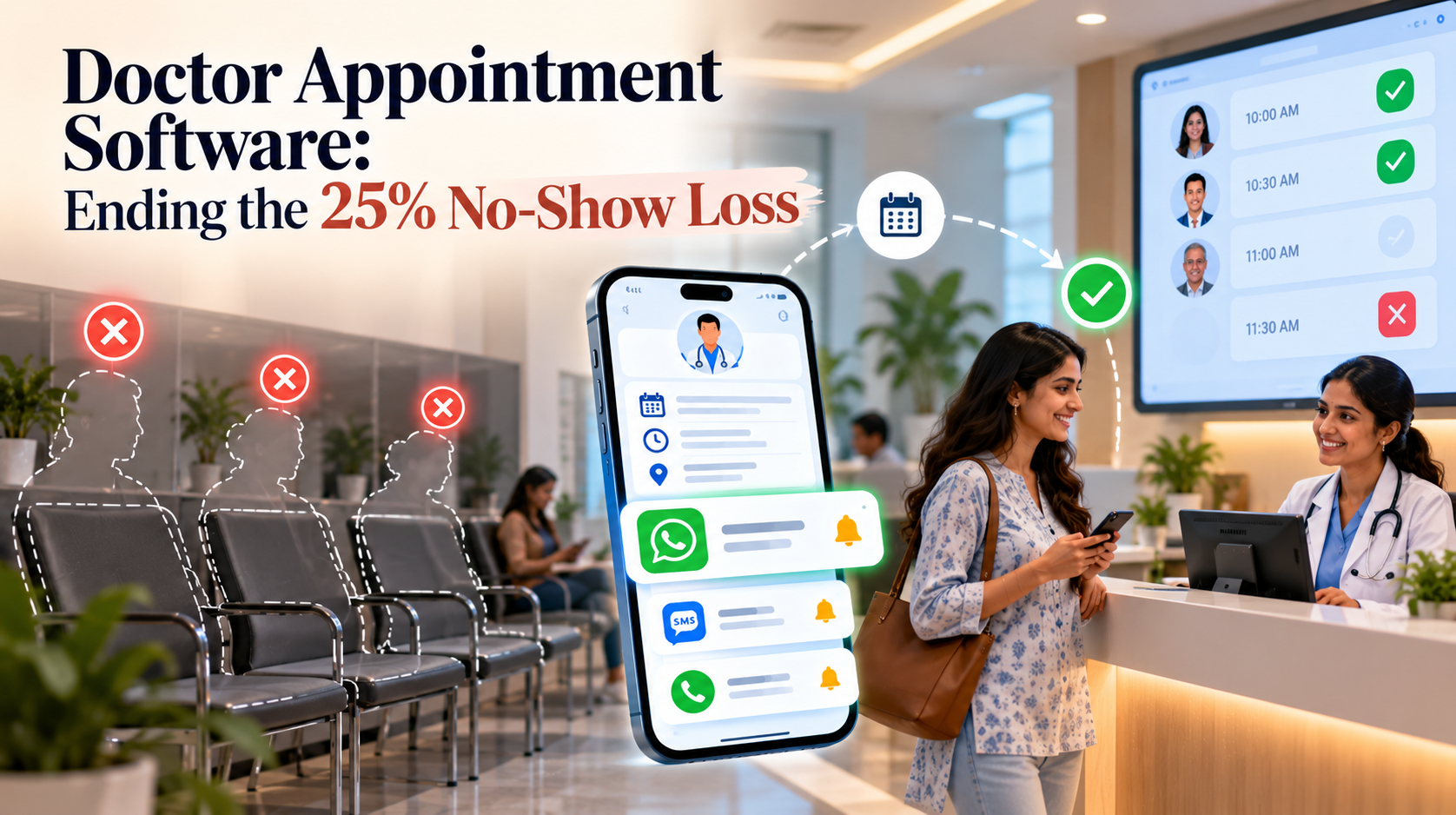
A 50 patient a day clinic in India loses roughly 2 lakh rupees a month to appointment no shows. Not to competitors. Not to bad reviews. To patients who booked, then forgot, then never came.
Multiply that across a full year and it is more than 24 lakh rupees of pure lost revenue, on top of the operational overhead of the wasted slots, and none of it shows up in any P and L line item because the appointment was never billed in the first place.
The interventions that actually reduce Indian clinic no show rates from 20 to 25 percent down to under 10 percent are well documented, easy to deploy, and require no additional staff. All of them run inside a properly configured doctor appointment software.
This piece covers what the no show number actually costs, why it is so high in Indian OPDs, the four interventions that consistently work, and the exact features to insist on when you evaluate a doctor appointment software vendor.
The Real Cost of Missed Appointments in India
The no show number is the most under measured metric in Indian outpatient healthcare. Every clinic knows it happens. Almost no clinic tracks it as a KPI. The math is simple and the results are painful.
Solo Clinic
50 patients booked per day, 20 percent no show rate, average consultation fee 500 rupees. Daily loss: 5,000 rupees. Monthly loss: 1.3 lakh rupees. Annual loss: 15 lakh rupees.
Polyclinic
150 patients booked across 4 doctors per day, 22 percent no show rate, average consultation fee 700 rupees. Daily loss: 23,000 rupees. Monthly loss: 5.9 lakh rupees. Annual loss: 71 lakh rupees.
Mid Sized Hospital OPD
300 patients booked per day, 25 percent no show rate, average consultation fee 800 rupees. Daily loss: 60,000 rupees. Monthly loss: 15.6 lakh rupees. Annual loss: 1.87 crore rupees.
Note: Every one of these numbers is recoverable. Not entirely, but the difference between a 22 percent no show rate and an 8 percent no show rate is between 60 and 65 percent of the leakage above. For the mid sized hospital, that is 1.2 crore rupees of annual revenue that simply reappears once the right systems are in place.
Whether you run a solo practice, a polyclinic, or a hospital OPD, the recovery framework is the same.
Why No Show Rates Are So High in Indian OPDs
Understanding the causes matters because it decides which interventions to prioritise. Four factors drive most of the Indian OPD no show pattern.
Patient Forgot
The most common cause, accounting for roughly 40 percent of no shows. Appointments booked one to three weeks in advance for follow ups, physiotherapy, chronic disease reviews, and immunisation visits are the most vulnerable. A single reminder the day before recovers most of this category.
Rescheduling Friction
Patients cannot easily reach the clinic to reschedule when something comes up. Phone lines are busy, WhatsApp is not monitored, the online booking link does not allow cancellation.
So they simply do not show up rather than fight through the friction to reschedule. This accounts for roughly 25 percent.
Long Booking to Visit Gap
Appointments booked more than 10 days in advance have a no show rate 2 to 3 times higher than appointments booked within 3 days. Long lead times are unavoidable in some specialities, but they compound the reminder and rescheduling problems above. Accounts for another 20 percent.
Casual Expectation of Walk In Availability
Indian patients often assume they can walk in even without an appointment, so booking feels non binding. This is cultural and slow to change, but confirmation nudges shift patient behaviour meaningfully over 60 to 90 days. Accounts for the remaining 15 percent.
The 4 Interventions That Actually Reduce No Shows
Every credible study of Indian outpatient no show reduction points to the same four levers, deployed together. Individual interventions produce marginal gains. Stacked, they cut no show rates by 60 to 70 percent within 90 days.
1. WhatsApp Reminder 24 Hours Before
The single highest impact intervention. Indian patients open WhatsApp messages within minutes, unlike SMS which many ignore. A short reminder with the doctor name, clinic name, date, time, and a one tap reschedule link cuts no shows by 30 to 40 percent on its own.
2. SMS Reminder 2 Hours Before the Visit
SMS is a secondary channel but works well for the morning of the visit, particularly for older patients less active on WhatsApp. Combined with the WhatsApp reminder from the day before, SMS delivers an additional 10 to 15 percent no show reduction.
3. Confirmation Call for High Value Appointments
For surgical consultations, chronic disease reviews, and any appointment above 1,500 rupees consultation fee, a live confirmation call from the front desk 4 hours before the visit reduces the no show rate on those specific slots by 50 to 70 percent.
Not scalable for every slot, but hugely valuable for the revenue heavy ones.
4. One Tap Rescheduling
A doctor appointment software that lets the patient reschedule from the reminder message itself removes the biggest cause of silent no shows. Patients who can reschedule with two taps do reschedule. Patients who cannot reach the clinic simply do not show up.
This intervention alone recovers 20 to 30 percent of what would have been lost slots.
What to Insist on in a Doctor Appointment Software
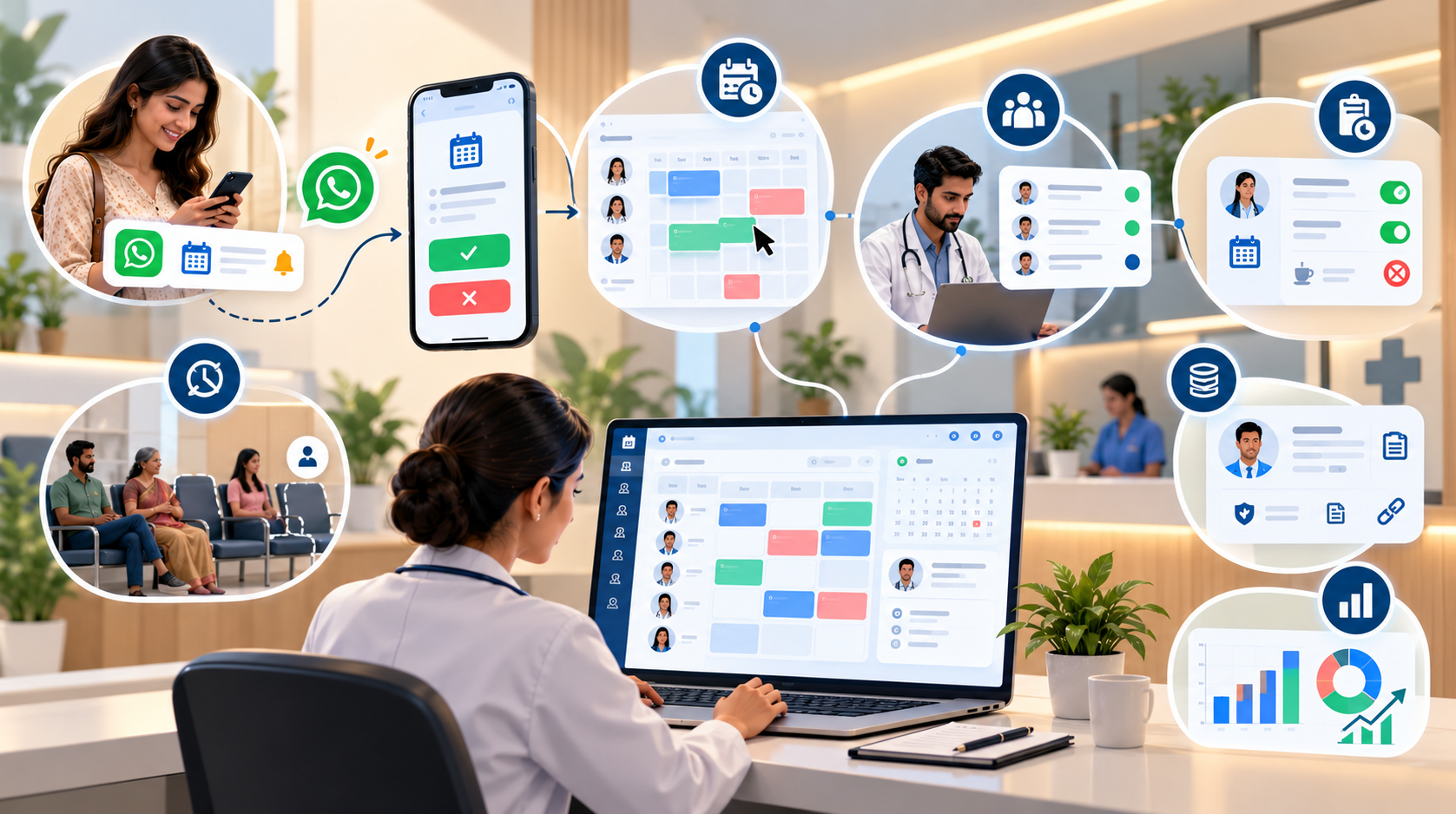
Not every platform marketed as doctor appointment software delivers the workflow depth required to actually reduce no shows. The minimum feature set:
- WhatsApp Business API integration for reminders, not just plain SMS gateway
- Automated reminder scheduling at multiple points (24 hours, 2 hours, day of visit)
- One tap reschedule and cancel from the reminder message
- Online booking link that patients can use from a mini website or shared URL
- Multi doctor and multi room scheduling with conflict detection
- Doctor availability rules (leave, breaks, blocked slots) that auto propagate
- Front desk view showing today's schedule with real time confirmation status
- Automatic waitlist that fills cancelled slots from patients waiting for that doctor
- Integration with the patient EHR so returning patients auto populate their record
- Reports on no show rate, on time arrival rate, doctor utilisation, and slot occupancy
For clinics working toward ABDM compliance, the appointment intake screen should also perform an ABHA lookup at booking. This pulls in the patient's demographics, insurance, and consented health record in seconds, eliminating manual re entry at the front desk.
It also sets up the patient record for downstream e-Prescription workflows during the consultation itself.
Manual Calendar vs Doctor Appointment Software
| Function | Manual Calendar | Doctor Appointment Software |
|---|---|---|
| Reminders | Front desk calls, hit or miss | Automated WhatsApp and SMS |
| Rescheduling | Requires phone call | One tap from reminder |
| Online booking | Not possible | Shareable link, 24/7 |
| Waitlist management | Paper list, rarely used | Auto fill from waitlist |
| Typical no show rate | 20 to 25 percent | 6 to 10 percent |
| Reporting | None | Full no show and utilisation reports |
Frequently Asked Questions
How much does doctor appointment software cost in India?
Cloud based doctor appointment software for a solo doctor typically costs 8,000 to 25,000 rupees per year. Polyclinics with multi doctor scheduling pay 30,000 to 1 lakh rupees per year. When bundled inside a clinic management platform, appointment scheduling is usually a native module at no incremental cost.
Which is more effective: SMS or WhatsApp reminders?
WhatsApp reminders outperform SMS by roughly 3 to 4 times in Indian clinics. Open rates on WhatsApp cross 90 percent within an hour. SMS open rates in urban India have declined to 30 to 40 percent, particularly among younger patients. Both should be used, with WhatsApp as the primary channel.
Can appointment software integrate with our existing EHR?
Yes, if the appointment module is part of the same EHR platform or if it exposes standard APIs for integration. Native integration inside a single platform is always cleaner than API integration between two separate tools, which creates sync gaps over time.
How long does it take to see no show rate improvement?
First improvement visible in 2 to 3 weeks once WhatsApp reminders go live. Full 60 to 70 percent no show reduction typically achieved within 90 days, once patients adjust to the confirmation habit and the front desk uses the reschedule waitlist actively.
Do patients need to install an app to receive reminders?
No. WhatsApp reminders go to the patient's existing WhatsApp account. Rescheduling happens through a web link in the message, not a separate app. This is a critical reason why WhatsApp based appointment software adoption is faster in India than app based approaches.
Where to Start
The fastest way to cut your no show rate is to start measuring it. Most Indian clinics quote 10 to 15 percent as their guess, when the real number is usually 20 to 25 percent.
Pro Tip: Pull last month's booked appointments against actual visits, calculate the gap, and multiply by the average consultation fee. The number is almost always higher than expected. That number is your recoverable revenue.
The National Health Authority digital health guidelines encourage clinics to track appointment adherence as one of the operational metrics that feed into the wider quality reporting framework, so measuring this also aligns you with the direction Indian healthcare regulation is moving.
SlateBiz builds CuraBiz, a unified healthcare platform with a doctor appointment software module tied to the EHR, billing, and WhatsApp Business integration on a single database. CuraBiz handles online and offline scheduling, automated multi channel reminders, one tap rescheduling, doctor availability management, and full no show reporting.
It is built on Java and Oracle with SHA 512 password hashing, Apache Shiro session security, and OWASP hardening. Clinics using CuraBiz appointment workflows typically cut no show rates from 20 plus percent to under 10 percent within 90 days.
Book a walkthrough: Reach out at info@slatebiz.com or call +91 92573 73668, or visit slatebiz.com to book a CuraBiz walkthrough.