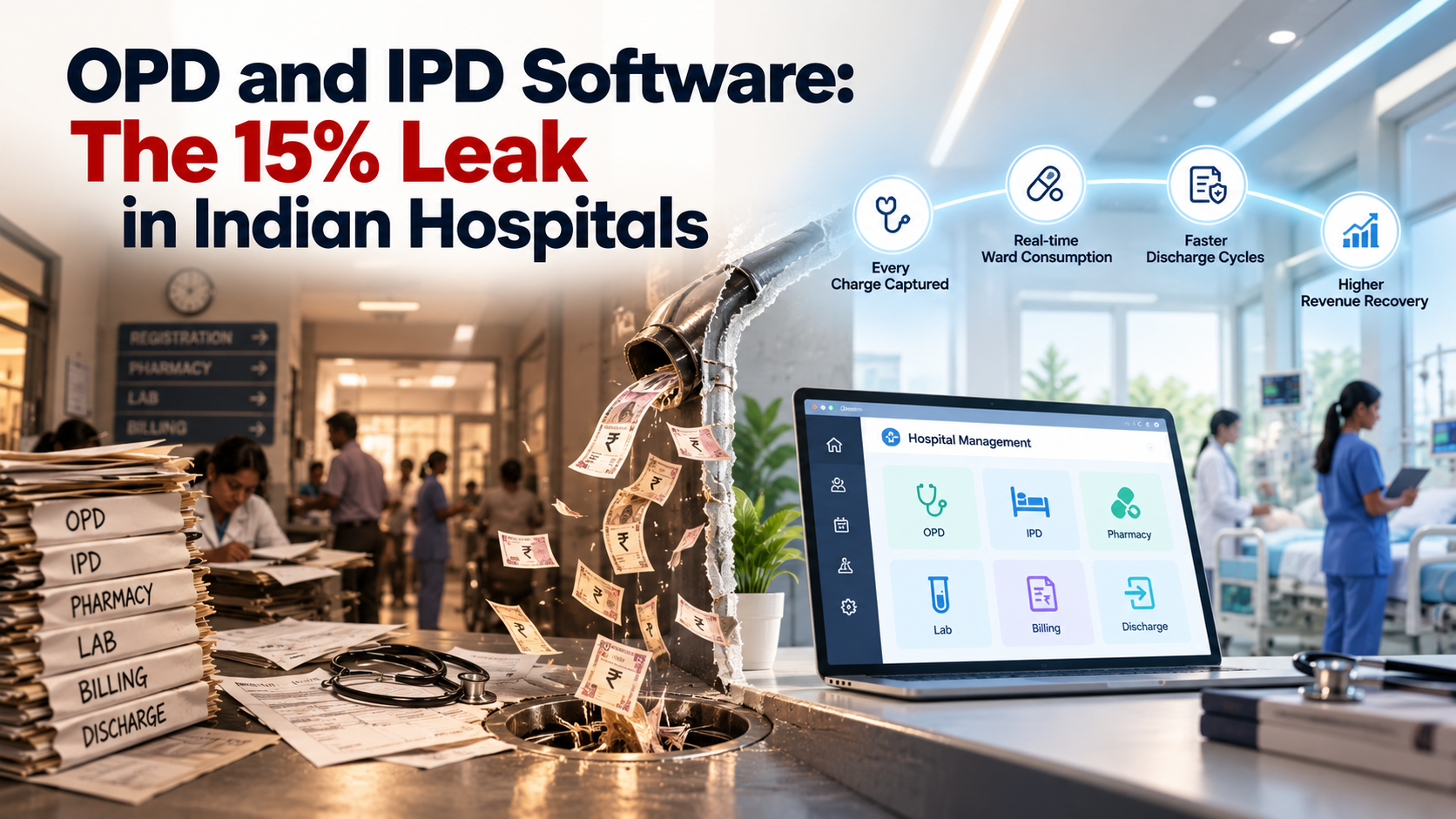
A 100 bed hospital in India running fragmented OPD and IPD workflows loses roughly 12 to 18 lakh rupees a month to unbilled procedures, missed charges, and slow discharge cycles. That is 1.5 to 2.2 crore rupees a year of pure operational leakage.
It is entirely separate from pharmacy losses, insurance rejections, or patient no shows. The leak happens in the OPD queue, on the IPD ward, at the pharmacy handover, and at the discharge counter. And it does not show up in any P and L line item because the charges were never billed in the first place.
Integrated OPD IPD software closes most of this leak within 60 to 90 days. It captures every charge at the point of delivery, ties ward consumption to the patient bill in real time, and generates discharge summaries structured enough for clean insurance settlement.
This piece breaks down where the money actually vanishes, what OPD and IPD workflows differ on, and the exact features to insist on when you evaluate OPD IPD software for an Indian hospital.
The Real Cost of Fragmented OPD IPD Operations
Different hospital sizes lose different amounts, but the percentage of revenue leaked is remarkably consistent across the Indian market. The math below is based on typical operating benchmarks from Tier 1 and Tier 2 city hospitals.
Small Hospital, 30 Beds
OPD 80 patients per day, IPD 15 active patients on average. Combined monthly revenue 45 to 65 lakh rupees. Typical fragmented workflow leakage: 6 to 10 lakh rupees per month, or 15 percent.
Mid Sized Hospital, 100 Beds
OPD 200 patients per day, IPD 60 active patients on average. Combined monthly revenue 1.2 to 1.8 crore rupees. Typical leakage: 15 to 22 lakh rupees per month.
Large Hospital, 250 Beds
OPD 500 patients per day, IPD 160 active patients on average. Combined monthly revenue 3 to 5 crore rupees. Typical leakage: 40 to 65 lakh rupees per month.
The recovery framework is the same at every scale. It requires an integrated hospital management system with tightly connected OPD, IPD, pharmacy, lab, and billing modules on a single database.
Note: Best of breed tools bolted together with file exports do not close this leak because the leak is not any single module. It is the gap between them.
Where OPD Loses Money
Outpatient volume is where most Indian hospitals see their patient count, and small inefficiencies compound across 200 to 500 patients a day. Effective OPD management software closes each of the four friction points below by design.
Missed Consultation and Procedure Charges
A doctor adds a minor procedure during the visit (dressing, nebulisation, injection) but the receptionist forgets to add it to the bill. A follow up visit is provided for free because the front desk assumed it was included in the last consultation. Typical loss: 2 to 4 percent of OPD revenue.
Slow Patient Turnover from Paper Based Flow
Registration takes 3 to 5 minutes on paper, versus under a minute with digital records and ABHA lookup. Consultation takes longer because pulling last visit's notes means fetching a physical file.
Multiplied across 200 patients, that is 3 to 5 hours of collective slowdown per day, translating directly into patients who cannot be seen and walk to a faster competitor.
Pharmacy Handover Leakage
The doctor prescribes 5 medicines. The patient goes to the hospital pharmacy, asks for 3 of them, buys 2 elsewhere. There is no link between the prescription and the pharmacy sale.
The hospital never captures the revenue from the 3 medicines the patient did buy inside. It also never records that the patient walked out with only partial medication.
Lab Test Order Without Billing
Doctor orders a lab test. Patient goes to the lab, gets the test, results are ready in an hour. Somewhere in that flow, the OPD billing counter never posts the lab charge because the lab and the OPD run on separate systems. Typical loss on this alone: 3 to 6 percent of monthly lab revenue on OPD patients.
Where IPD Loses Money
Inpatient charges accumulate over 2 to 15 days per patient. Small daily losses compound into large amounts by discharge. IPD is where the 10 to 20 percent revenue leakage that plagues manual hospitals mostly lives.
Strong IPD management software, combined with a proper ward management and bed management system, delivers the highest return on the technology investment. It also aligns with Ayushman Bharat Digital Mission requirements for structured inpatient records under M2 compliance.
Ward Medicine Consumption Not Billed
A nurse pulls medicines from the ward cabinet for a patient, notes it on a slip, slip goes missing. Multiplied across 60 IPD patients and 8 nurse shifts a day, this alone accounts for 4 to 8 percent of monthly IPD revenue.
The fix requires digital ward cabinet interfaces tied to patient IDs, not paper slips.
Consumable and Disposable Leakage
Syringes, gloves, dressings, catheters, and disposables consumed during the stay often get bundled into a daily flat charge rather than tracked individually. Bundled charges under estimate real consumption for high acuity patients and over estimate for stable patients, leaking revenue on one and creating patient disputes on the other.
Slow Discharge Summary and Bill Closure
A manual discharge summary takes 3 to 6 hours to compile. The doctor writes it, the front desk types it, the billing team reconciles charges, and the insurance claim team packages it for the TPA. During this time the bed cannot turn over for the next admission.
For a 100 bed hospital, cutting discharge time from 4 hours to 1 hour releases 15 to 20 additional beds per month, worth 8 to 15 lakh rupees in incremental revenue.
Doctor Visit Charges Not Captured
Consultants visit patients during morning and evening rounds. Each visit is a billable event. In fragmented systems, these visits get logged on paper and only a fraction end up on the final bill. Typical loss: 15 to 25 percent of consultant visit revenue during IPD stays.
What Integrated OPD IPD Software Actually Delivers
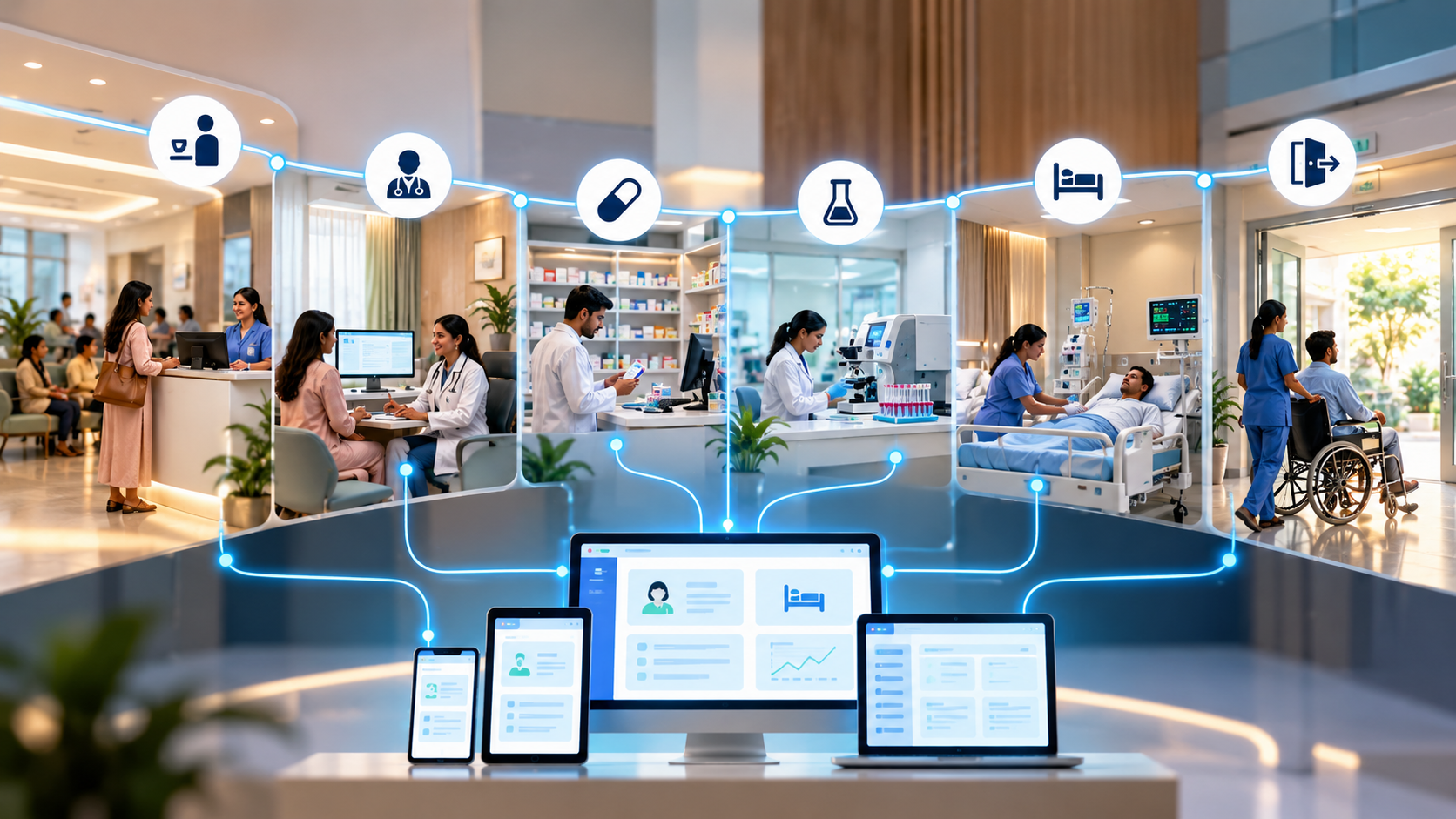
The technical fix for the leakage above is not a smarter billing tool. It is charge capture at the point of delivery, enforced by workflow, not by human memory. A serious OPD IPD software module inside a broader hospital management platform delivers the following as standard.
OPD Capabilities
- OPD registration in under a minute with ABHA lookup and returning patient auto populate
- Token queue management visible to patients on a screen or WhatsApp
- Consultation screen that auto adds procedure and follow up charges to the running OPD bill
- Doctor prescription flowing directly to pharmacy dispensing without retyping
- Lab test orders posting charges to the OPD bill at order time, not after result
IPD Capabilities
- IPD admission with automated room allocation
- Ward management with live bed status, ICU allocation, and shift handover
- Bed management system with real time occupancy, turnover tracking, and admission wait list
- Ward medicine cabinet interface tied to patient ID for consumption tracking
- Nursing notes, vitals, and IV chart integrated with the patient EHR
- Automatic doctor visit charge capture during ward rounds
- One click discharge summary generation from clinical notes and consumption logs
- Real time IPD bill visible to the family for transparency during the stay
OPD vs IPD: What Each Workflow Actually Needs
| Workflow | OPD Software Needs | IPD Software Needs |
|---|---|---|
| Patient identity | Fast registration, UHID, ABHA lookup | Admission with room allocation and consent |
| Charge capture cadence | Real time at each service | Continuous across 2 to 15 days |
| Clinical documentation | Consultation notes and prescription | Nursing notes, vitals, procedures, doctor visits |
| Pharmacy link | Prescription to counter dispensing | Ward cabinet consumption to patient bill |
| Billing closure | Same day, at exit | At discharge, with insurance package |
| Bed and room tracking | Not required | Live ward status, ICU allocation, turnover |
| Discharge document | Not applicable | Automated summary from clinical notes |
Frequently Asked Questions
What is the cost of OPD IPD software for an Indian hospital?
A standalone OPD management software module for a mid sized hospital runs 1 to 3 lakh rupees per year. A standalone IPD management software module runs 2 to 4 lakh rupees per year. Integrated OPD IPD software bundled inside a full hospital management platform typically costs 3 to 8 lakh rupees per year for a 100 bed hospital. The bundled option delivers better economics because pharmacy, lab, and billing integration eliminates the leakage standalone tools cannot fix.
Can I buy OPD software only and add IPD later?
Yes, but for a hospital with active IPD operations it usually costs more over three years than starting with an integrated platform. Adding IPD to an OPD only system typically requires data migration and staff retraining, which combined runs 40 to 60 percent of the original software cost.
How long does OPD IPD software implementation take?
A 30 bed hospital typically goes live in 3 to 4 weeks. A 100 bed hospital takes 6 to 10 weeks with data migration and staff training. A 250 bed multi specialty hospital takes 10 to 14 weeks including IPD ward rollout, ICU integration, and OT scheduling.
Does OPD IPD software integrate with existing pharmacy and lab tools?
It can, through APIs, but integrated deployment inside a single platform delivers materially better outcomes than API integration between separate tools. The leakage the software is meant to close mostly lives in the gaps between systems. Native integration removes those gaps by design.
Is OPD IPD software required for NABH accreditation?
Under the NABH 5th edition standards, digital OPD and IPD documentation with audit trails is effectively required. Paper based OPD IPD workflows consistently trigger non conformity findings during accreditation assessments. Hospitals pursuing NABH accreditation should treat integrated OPD IPD software as part of the preparation, not a separate project.
Where to Start
The fastest way to quantify your OPD IPD leakage is a two week audit.
Pro Tip: Pull last month's OPD registration count and reconcile against consultation charges billed. Pull IPD ward medicine consumption logs and reconcile against patient bills. The gap between what was delivered and what was billed is the recoverable revenue.
In most Indian hospitals running fragmented systems, that gap is between 12 and 20 percent of monthly revenue.
SlateBiz builds CuraBiz, a unified healthcare platform with integrated OPD, IPD, pharmacy, laboratory, and billing modules on a single database. CuraBiz handles OPD registration with ABHA lookup, token queue management, IPD admission and ward allocation, nursing notes, ward medicine consumption tracking, automatic doctor visit charge capture, and one click discharge summary generation.
It is built on Java and Oracle with SHA 512 password hashing, Apache Shiro session security, and OWASP hardening. Hospitals using CuraBiz for OPD IPD workflows typically close 60 to 80 percent of the 15 percent revenue leakage described above within 90 days.
Book a walkthrough: Reach out at info@slatebiz.com or call +91 92573 73668, or visit slatebiz.com to book a CuraBiz walkthrough.