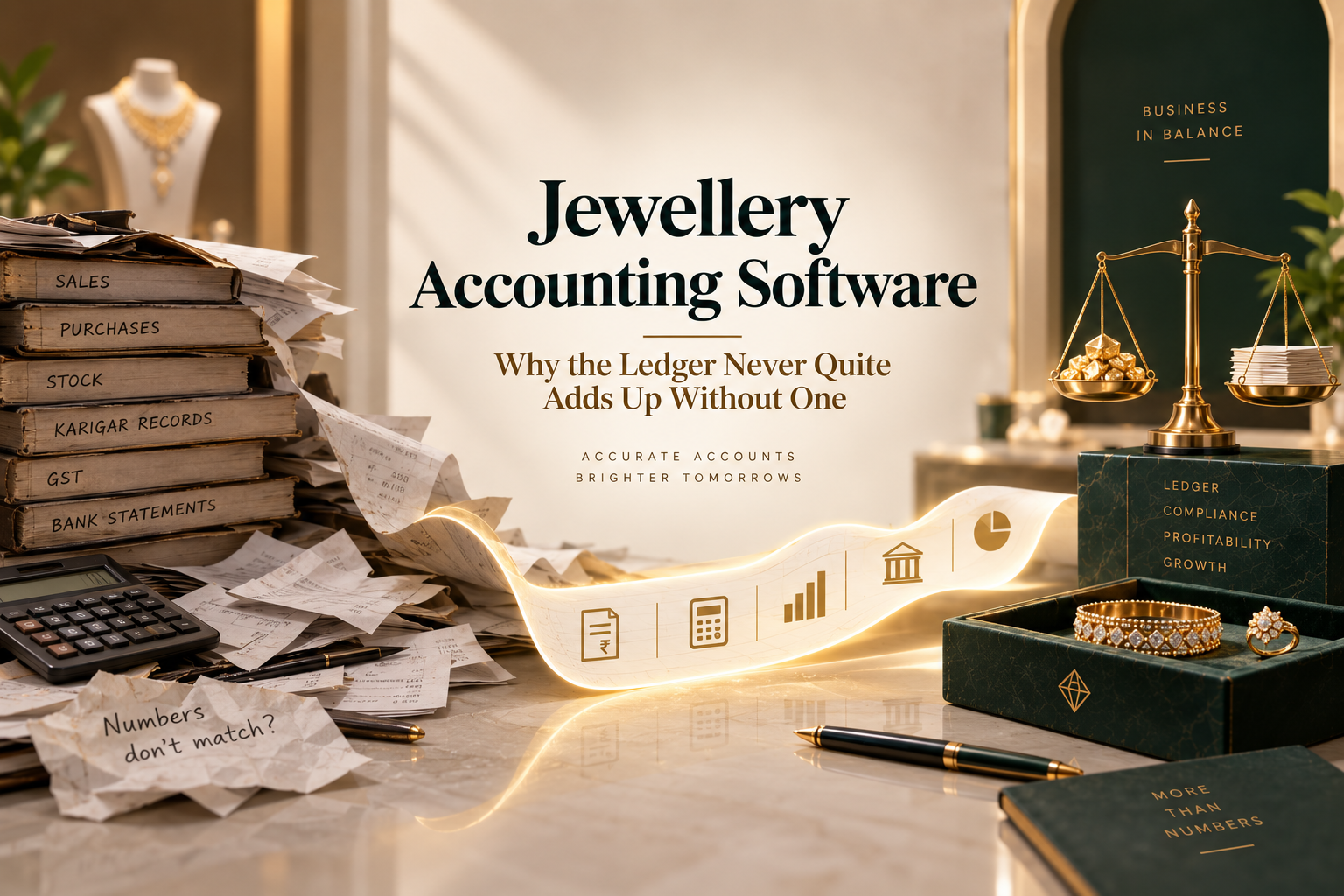
Ask a jewellery business accountant what the hardest part of the job is, and most will say the same thing: closing the books. Three different records, the billing software, the accounting software, and the owner's own register, all show slightly different numbers. Jewellery accounting software exists to close that gap, and most software sold under that name still doesn't.
Why jewellery accounting is not like other retail accounting
In most businesses, cost of goods sold is stable from one day to the next. In jewellery, it moves with the gold or silver rate, sometimes several times in a single day. An accountant using generic accounting software has to manually recalculate stock value, margin, and even outstanding customer dues every time the rate shifts meaningfully. Miss an update and the books quietly drift out of sync with what's actually on the shelf.
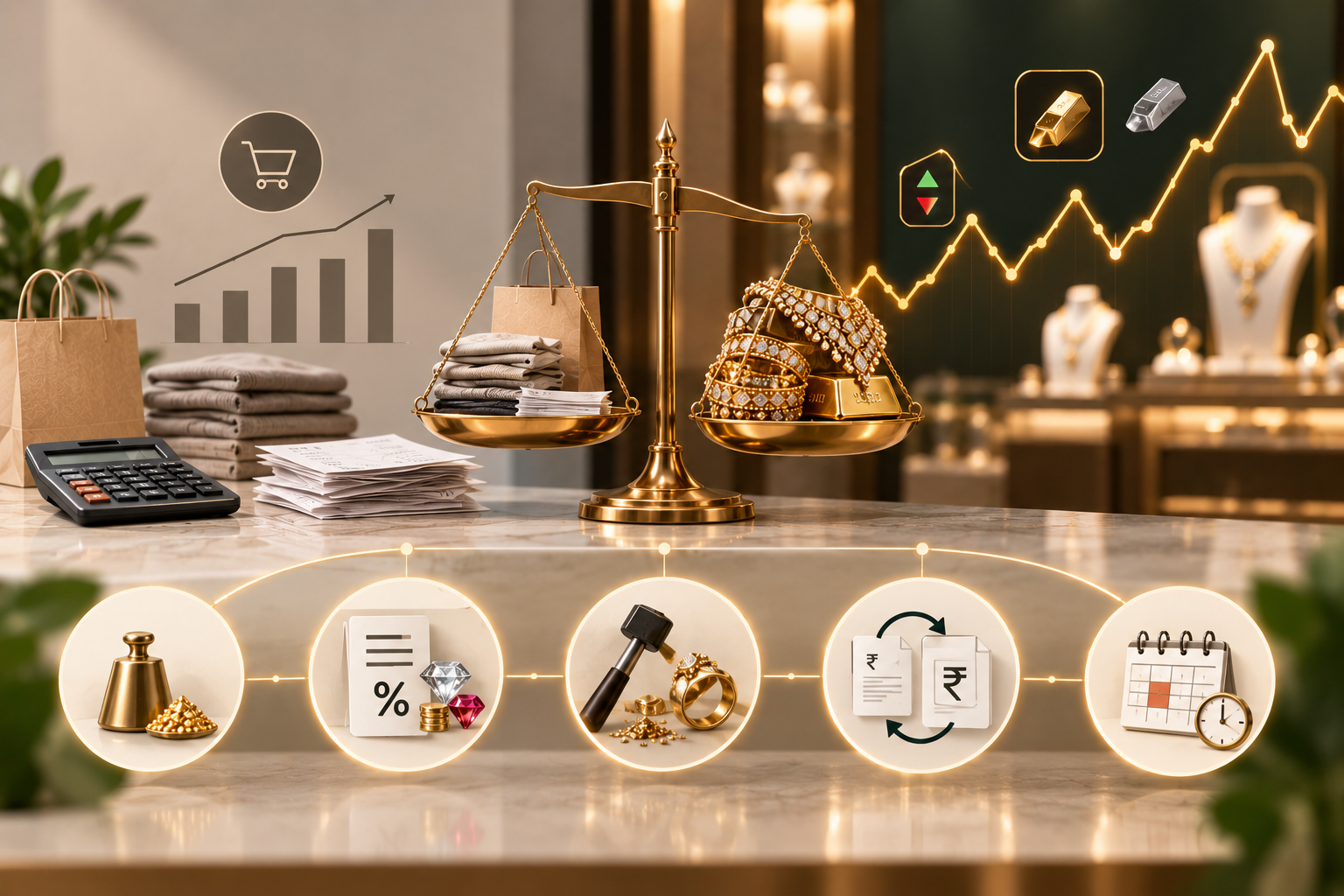
Where the numbers actually stop matching
1. Fine weight that nobody can state exactly
Jewellery is bought and sold in gross weight but valued in fine weight after adjusting for purity. A small rounding error in that conversion, repeated across hundreds of transactions a month, adds up to a real discrepancy by the time a stock audit happens. Most accounting software was never built to track this conversion at the line item level, so the error sits buried until someone finally goes looking for it.
2. GST split across metal, making and stone
Jewellery GST applies differently to metal value, making charges, and stone value, all inside a single invoice. Software that treats GST as one flat number on the bill makes it nearly impossible to reconstruct that breakdown later. Ask most jewellers to show exactly how much tax was collected on making charges alone across a quarter, and the honest answer is that nobody actually knows without going back through every invoice by hand.
3. Karigar wastage settled from memory, not from data
Metal goes out to a karigar, comes back as a finished piece, and the wastage allowed in between is often accepted on trust rather than measured. That wastage is a real accounting figure, it affects cost of goods sold and margin, but without a system tracking it job by job, it lives in the karigar's word, not in the ledger.
4. Input tax credit that never quite reconciles
A jewellery business often buys raw gold, sends it for manufacturing, and sells the finished piece. Sometimes that happens across separate GST registrations for the manufacturing and retail sides. Every one of those transactions needs to reconcile against GSTR-1 and GSTR-3B filings. Manual reconciliation at this level is where most compliance penalties actually start. It is rarely a misunderstood rate, it is a mismatch nobody caught in time.
5. A closing that takes a week instead of a day
Consider a showroom with two counters and a small manufacturing workshop. On a normal month, that means a few hundred sales invoices, a dozen purchase entries from suppliers, metal issued to two or three karigars, and a handful of exchange transactions, all needing to close into one set of books. In a business running billing, stock, and accounting as three separate tools, closing that month means exporting each one, lining the numbers up by hand, and chasing down whichever figure doesn't match. That process alone can eat the better part of a week for an accountant who could otherwise be reviewing the numbers instead of assembling them. In a business running jewellery accounting software connected to the same ledger as billing and stock, that same close is largely already done, because every invoice, purchase, and job work entry posted to the ledger the moment it happened. The accountant's week goes into checking the numbers, not creating them.
What jewellery accounting software actually needs to do
- Split GST automatically between metal value, making charges and stone on every invoice, not reconstructed later
- Revalue stock automatically against live MCX or IBJA rate feeds instead of a manual rate entry step
- Track karigar wastage and work in progress at the job level, not as a bulk monthly estimate
- Generate GSTR-1 and GSTR-3B ready reports that map to actual stock and sales data, not a generic sales ledger
- Flag input tax credit mismatches before they turn into a filing error
- Handle TDS, bank reconciliation, and day end closing on the same ledger as billing and stock, not a separate export
Jewellery accounting software versus generic accounting packages
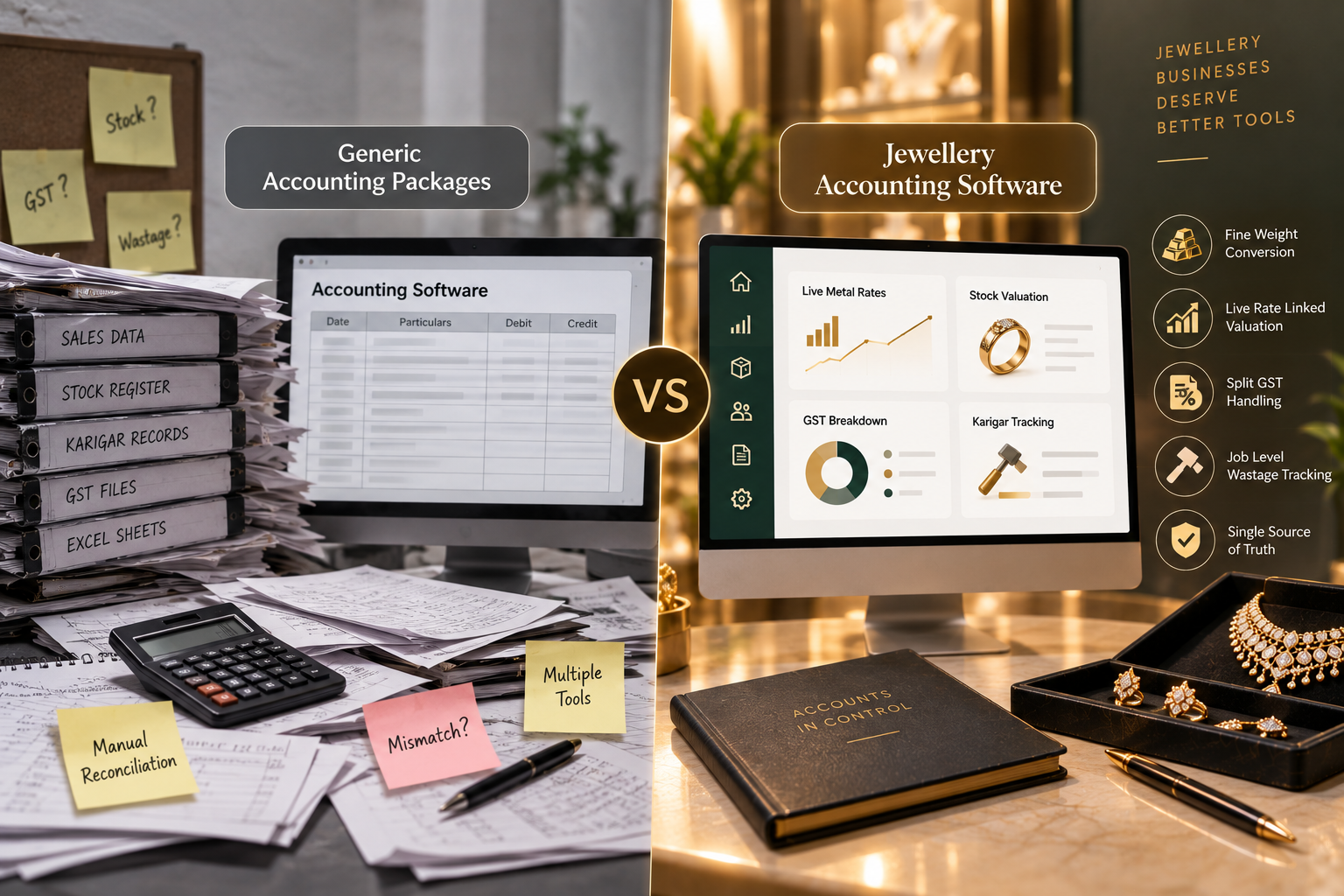
A general accounting package can be configured to record jewellery sales, but it was never built to treat fine weight, karigar wastage, or split GST as core concepts. Generic accounting tools are capable for general purpose bookkeeping, and plenty of jewellers have used them for years out of habit. None of them have fine weight conversion, live rate linked stock valuation, or job level wastage tracking as a native feature. Jewellers end up bolting on spreadsheets and manual registers just to cover the gap, which means the accounting system stops being the single source of truth the moment those spreadsheets exist. This is one reason a connected complete jewellery ERP system tends to outlast a patchwork of standalone tools.
What to check before choosing jewellery accounting software
- Does it split GST across metal, making and stone automatically, or does someone reconstruct that breakdown before filing
- Does stock valuation update against a live gold and silver rate, or does someone key in a rate manually
- Is karigar wastage tracked per job, or estimated in bulk at month end
- Do GSTR-1 and GSTR-3B reports generate from actual billing and stock data, or get rebuilt separately before every filing
- Does it flag ITC mismatches automatically, or only surface them once a notice arrives
- Does accounting sit on the same ledger as billing and stock, or does someone export and reconcile between systems, the same question worth asking of any jewellery billing software before it goes live at the counter
Frequently asked questions
What makes jewellery accounting software different from regular accounting software?
Regular accounting software treats every sale as a flat line item. Jewellery accounting software has to track fine weight, purity, karigar wastage, and GST split across metal, making and stone, all as core parts of the transaction, not manual add ons.
Can jewellery accounting software handle GST automatically?
A properly built one should. GST should split correctly between metal value and making charges the moment a bill is created, with GSTR-1 and GSTR-3B reports generated directly from that same data instead of reconstructed manually before filing, the same principle covered in our breakdown of the GST rate on gold jewellery.
Does jewellery accounting software replace general accounting tools?
For jewellery specific needs, yes, it should. General purpose accounting tools were never built around fine weight conversion or karigar wastage tracking. Purpose built jewellery accounting software covers the same accounting fundamentals while also handling what makes jewellery accounting different, including how gold making charges get taxed and reported.
Is jewellery accounting software the same as jewellery ERP software?
Accounting is one module inside a full jewellery ERP. Accounting software alone handles the ledger, GST, and financial reporting. A complete jewellery ERP software platform connects that same accounting data to billing, inventory and manufacturing on one system. Our guide to jewellery ERP software covers the full picture module by module.
How JewelBiz Keeps the Ledger and the Shop Floor in Sync
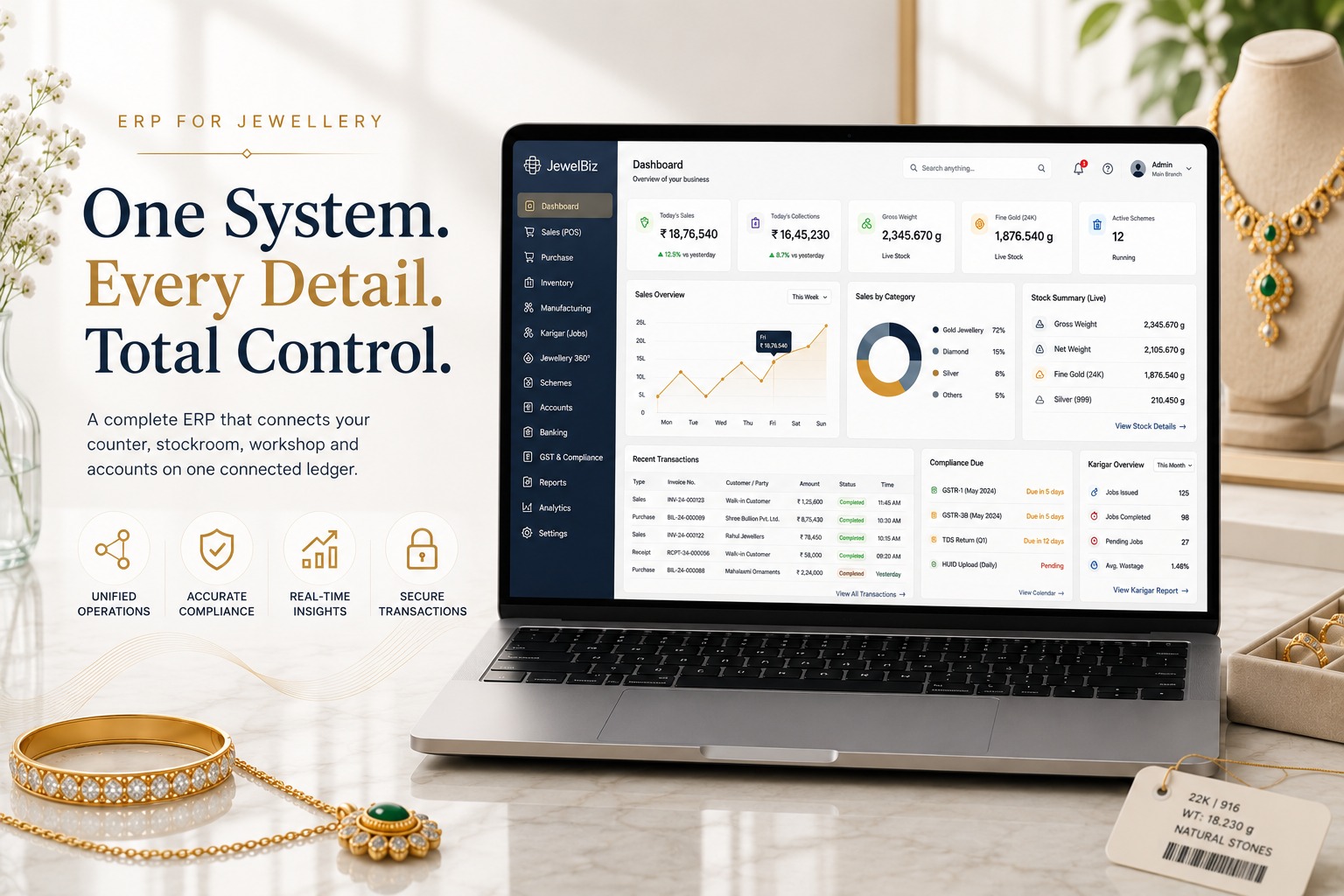
JewelBiz splits GST across metal, making and stone automatically on every invoice, revalues stock against live MCX and IBJA rates, and tracks karigar wastage at the job level instead of a monthly estimate. GSTR-1 and GSTR-3B reports generate straight from actual billing and stock data, so filing pulls from numbers that already exist rather than numbers someone has to rebuild. Accounting sits on the same connected ledger as billing, inventory and manufacturing, the same system covered in our guides to jewellery billing software and a jewellery management system. The books and the shop floor never drift apart in the first place. If you want to see how it handles your own store's numbers, reach out at info@slatebiz.com or call +91 92573 73668, or visit slatebiz.com to book a walkthrough.