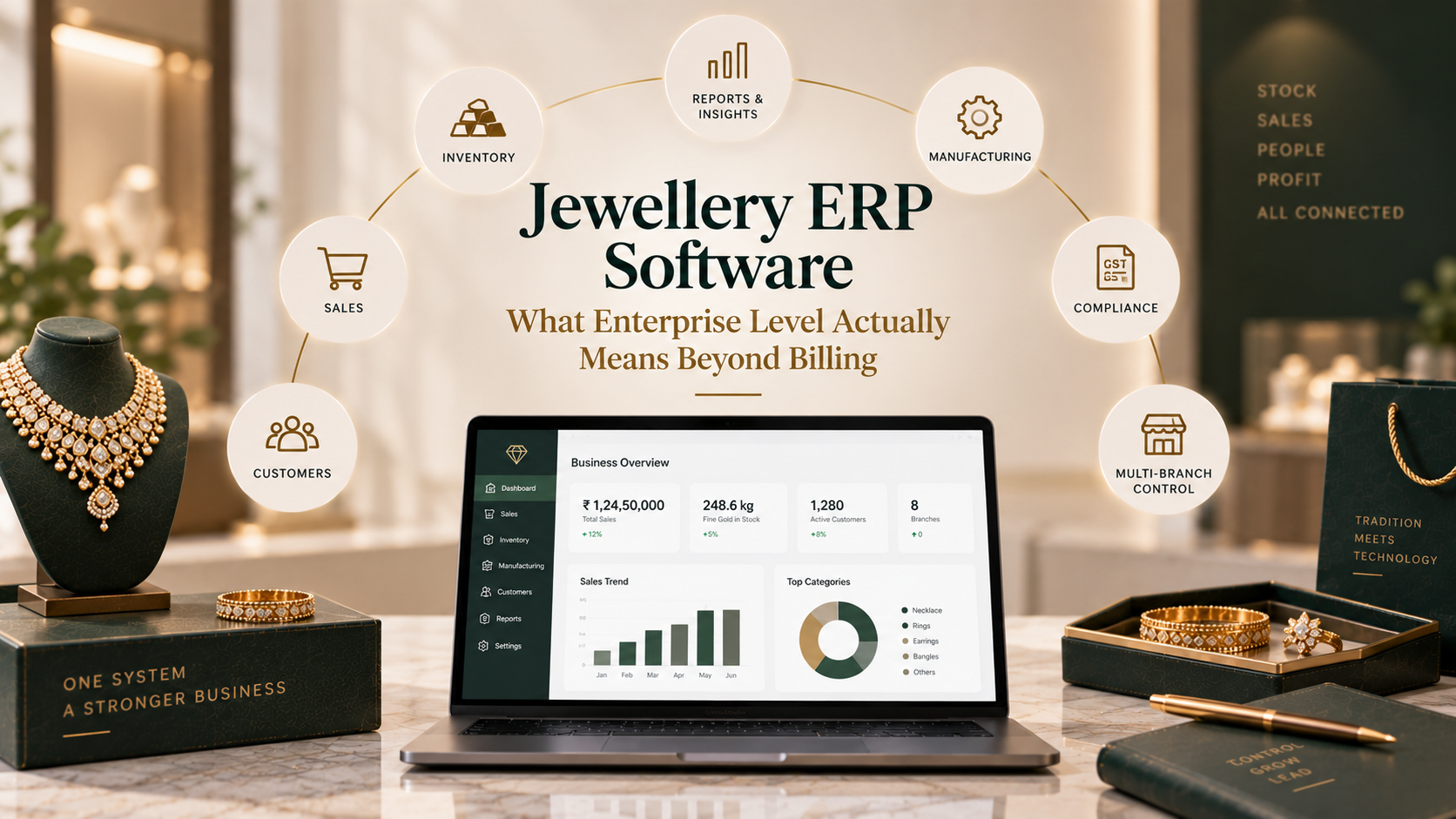
Most jewellery businesses start with billing software and add pieces on as problems show up, a stock spreadsheet here, a separate karigar register there, a manual GST reconciliation before every filing. Jewellery ERP software takes the opposite approach. It starts from the assumption that stock, sales, manufacturing, staff accountability and compliance all belong on one system, because a business owner spending hours reconciling accounts and chasing stock discrepancies is not a billing problem, it is a control problem.
What jewellery ERP software actually needs to control
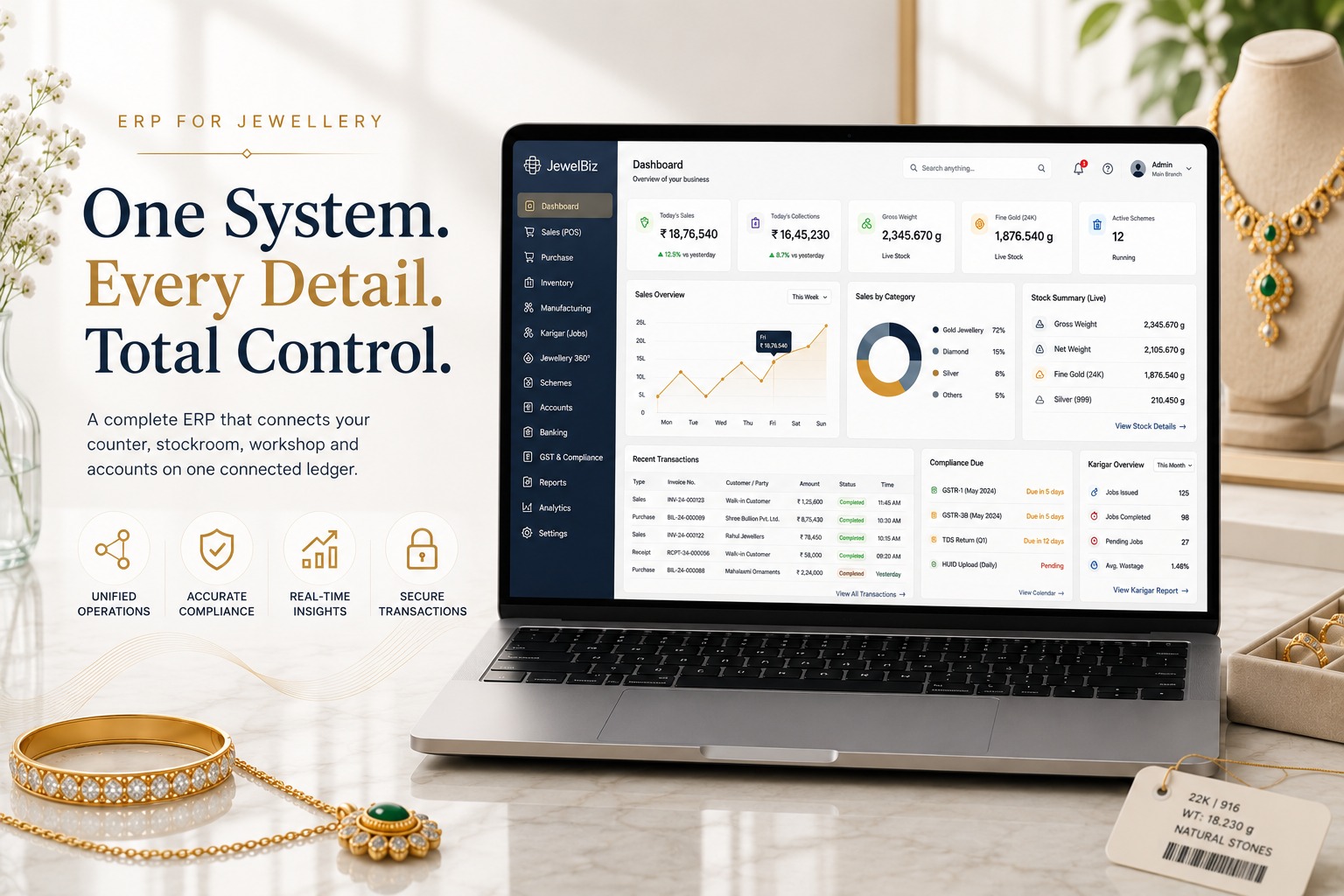
Digitising an invoice is the easy part. Real jewellery ERP software secures the fine metal position across every branch, automates tax compliance instead of reconstructing it at filing time, closes the gaps where stock quietly goes missing, and gives leadership a live view of the business instead of a report someone builds at month end.
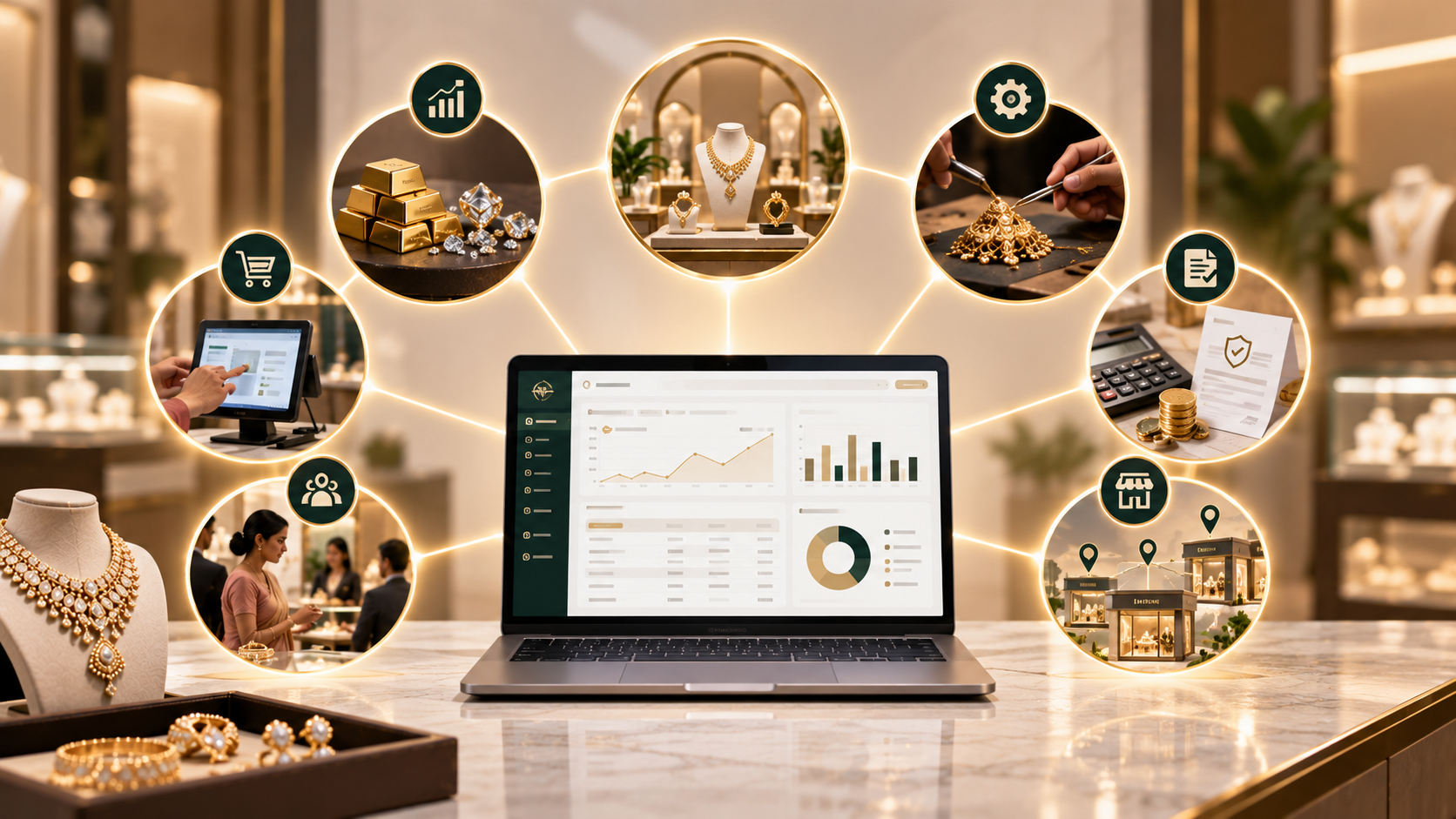
1. Automating the counter so staff can focus on the customer
Manual entry across billing, stock ledgers, purchase orders, customer records and GST calculations eats hours every day. That time should go to the customer standing at the counter, not to paperwork. When the point of sale terminal syncs instantly with inventory and accounting, paperwork disappears from the transaction, and staff time goes back into service rather than data entry.
2. Real time visibility across stock, cash and bank
In a jewellery showroom, even a small stock discrepancy is a meaningful financial exposure. Leadership needs instant visibility across sales, stock position, cash drawers, bank balances, net margin, outstanding payables and job work in progress. That view should be live, not a figure that gets assembled once a month.
The table below shows what changes when a business moves from a fragmented, manual approach to one connected system.
| Operational area | Fragmented approach | Jewellery ERP software | What changes |
|---|---|---|---|
| Inventory and fine weight | Estimated counts, manual tallies | Live barcode and RFID tracking with purity split | Stock value is a number, not an estimate |
| Multi branch control | Manual reconciliation at month end | Instant cloud sync across outlets | Every branch shows the same numbers, always |
| Karigar workshop | Paper notebooks, memory based settlement | Job cards, metal issue and wastage tracked automatically | Wastage is measured, not assumed |
| Compliance | GST filed after the fact, frequent mismatches | GSTR ready reports and hallmark logs generated live | Filing pulls from data that already exists |
3. Granular stock control beyond a fixed price SKU
Generic retail software treats every item as a SKU with a fixed price. Jewellery ERP software has to track far more: item ID, barcode or RFID tag, gross weight, stone weight, net purity, fine weight equivalent, wastage allowance, making charges, physical location, and full sale or exchange history. That level of detail is what closes the reconciliation gap that plagues manual vault management. Every gram of gold and every certified stone stays accounted for from purchase through to sale. Our guide to jewellery inventory management covers this piece in more depth.
4. Building real employee accountability
In a high value retail environment, accountability has to be built into the system, not enforced after the fact. A proper audit trail records who did what, at every step. It shows which employee created a quotation, which manager approved a discount, which clerk generated the invoice, which cashier took the payment, and which staff member handed the item over. That level of detail makes mistakes and unauthorised changes visible immediately instead of surfacing months later.
5. Catching leakage before it becomes a loss
Profitability erodes quietly. Excessive discounts, unauthorised price overrides, frequent bill cancellations, sudden stock adjustments, negative inventory entries, negative cash, unusual wastage percentages, and manual journal entries all chip away at margin without anyone noticing in the moment. Jewellery ERP software flags these the moment they happen rather than leaving them to surface during an annual audit. That is the difference between catching a problem in a week and catching it in a year.
6. Answering customers instantly, not eventually
A customer might ask whether a design is in stock, what the current gold rate valuation comes to, what an old gold exchange is worth, making charges, GST charges, or when a custom order will be ready. Every one of those deserves an answer on the spot, not a search through a paper register. A system that surfaces this instantly changes how the whole interaction feels to the customer, not just how fast the bill prints.
7. Bringing the karigar workshop onto the same system
Manufacturing introduces a supply chain most billing software never touches, precious metal issued to external karigars and workshops. Without tight tracking, that metal can go missing in wastage. A job can also run late without anyone noticing until it is overdue. A dedicated manufacturing module inside the jewellery ERP handles the full cycle: issuing raw metal, generating job cards, tracking production, checking weight and purity on return, and reconciling artisan payment against the job.
8. Replacing intuition with actual numbers
- Which product categories and designs actually move fastest
- Which pieces have quietly become dead stock
- Which sales staff convert at the highest rate
- Which branch delivers the best return
- Exactly how much fine gold sits in vault stock and active job work right now
These are the questions a business owner should be able to answer in a few clicks, not questions that require building a report from five different exports first.
9. Running every branch on one ledger
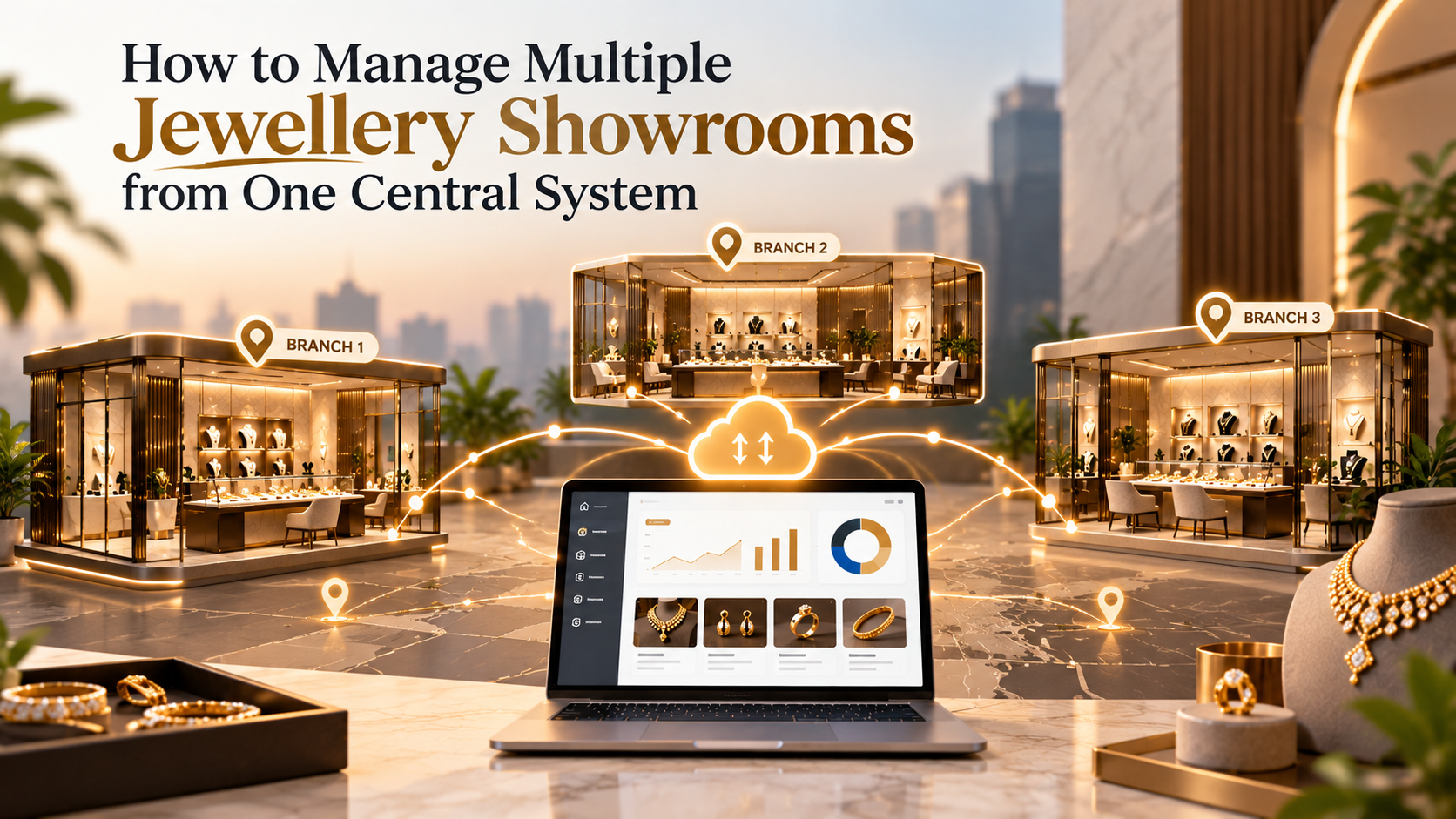
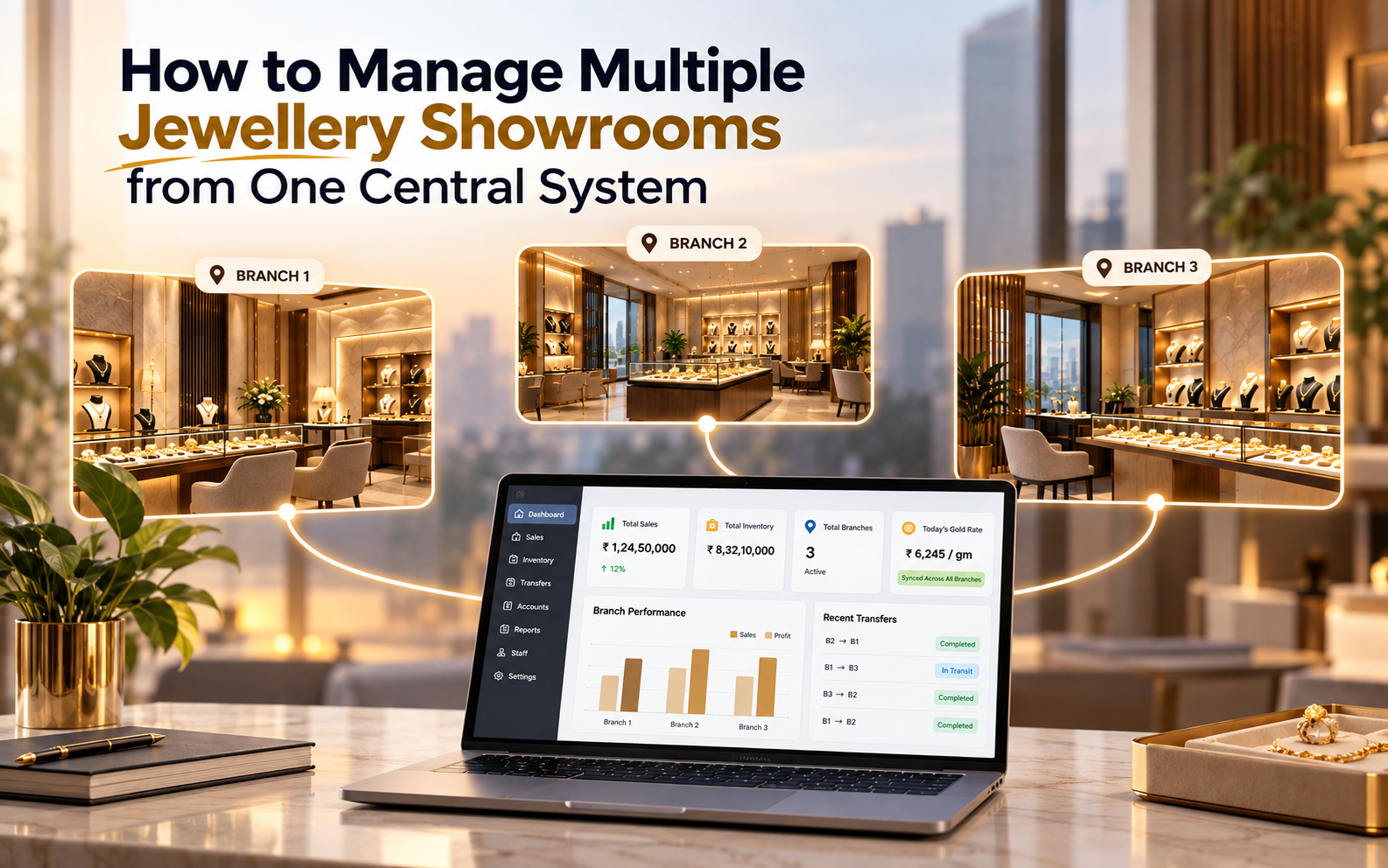
Growing from a single boutique to a multi branch chain adds real administrative weight. Jewellery ERP software puts the head office, every branch, any regional warehouse, and the manufacturing workshop on one synchronised ledger. Leadership can then see branch level sales, transfers and cash flow without visiting every location in person. Our guide to a jewellery management system walks through what this looks like across one full working day.
Jewellery ERP software versus jewellery billing software
Jewellery billing software gets the counter right. Jewellery ERP software does that and connects it to stock, manufacturing, staff accountability and compliance on the same data, which is the difference between speeding up the sale and actually running the business. See our guide to jewellery billing software for what the counter specific piece should cover on its own, and our guide to ERP for jewellery for the module by module breakdown of a complete system.
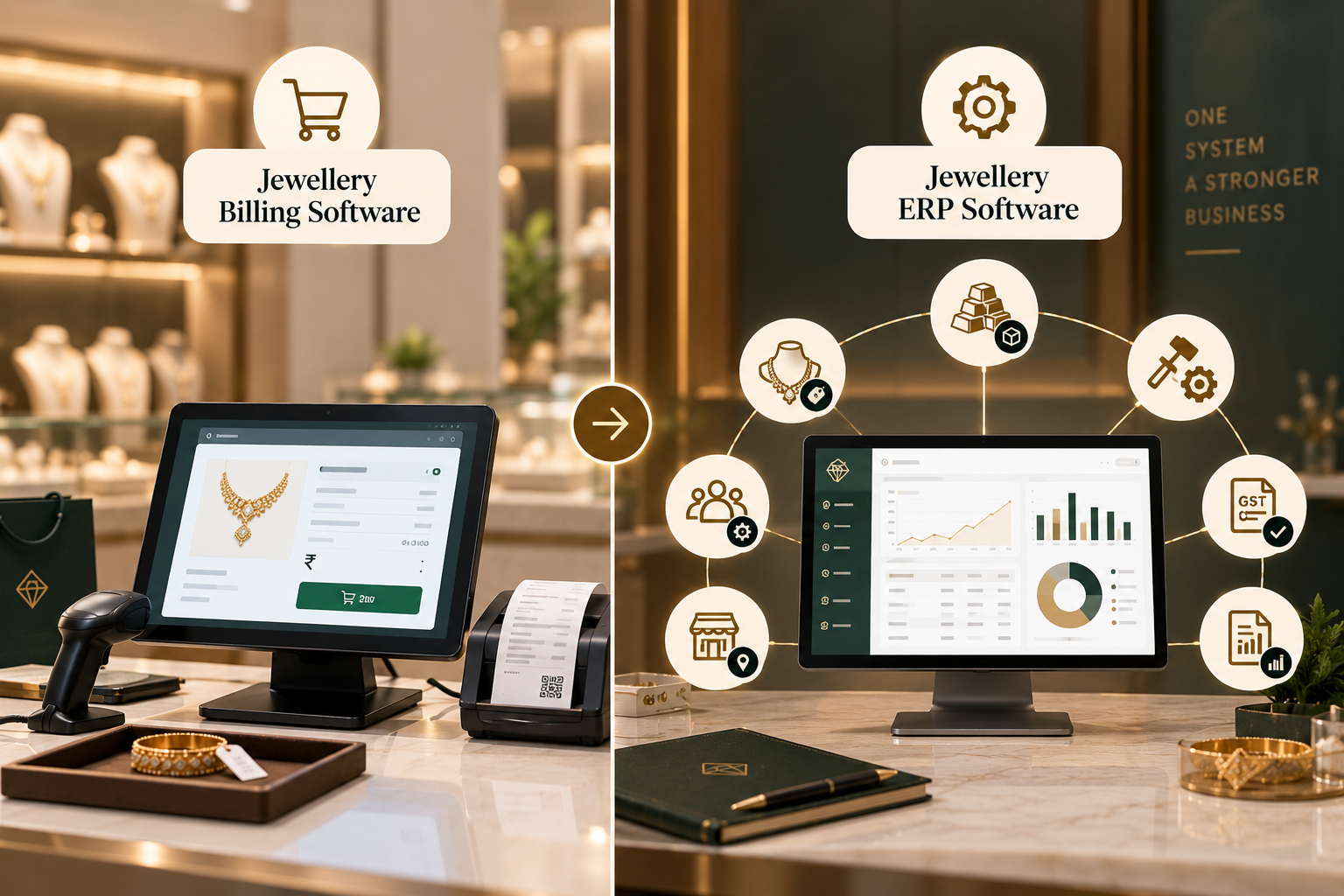
What to check before choosing jewellery ERP software
- Does it track fine weight and purity live, or does someone reconcile it manually at month end
- Does every branch see the same stock and cash position instantly, or does head office wait for a manual rollup
- Is karigar job work tracked with wastage measured per job, or does that still run on trust
- Does it flag unusual discounts, cancellations, or stock adjustments as they happen, or only during an audit
- Is GST and hallmark compliance generated from live data, or rebuilt before every filing
- Does analytics answer real business questions on demand, or require manually combining several reports
Frequently asked questions
What makes jewellery ERP software different from regular accounting software?
Regular accounting software was not built to track fine weight, purity, karigar wastage, or GST split across metal, making and stone. Jewellery ERP software treats these as core parts of the system rather than manual workarounds bolted onto a generic tool.
Can jewellery ERP software handle multiple branches?
Yes, when built for it. Every branch should sync to the same ledger in real time, so leadership sees consolidated stock, sales and cash position without waiting for a manual monthly rollup.
Does jewellery ERP software help prevent fraud and stock leakage?
A properly built system flags unusual activity, excessive discounts, unauthorised overrides, sudden stock adjustments, as it happens, along with a full audit trail tied to each employee, instead of surfacing the problem months later during an audit.
Is jewellery ERP software only useful for large jewellery chains?
No. A single showroom benefits from the same fine weight tracking, compliance automation and karigar management as a multi branch chain, the difference is usually which tier of features gets switched on as the business grows.
Moving from a collection of tools to one control system
The point of adopting jewellery ERP software is not faster invoice printing. It is replacing a collection of disconnected tools, a billing screen, a stock spreadsheet, a karigar notebook, a GST reconciliation done under deadline, with one system that gives the business clarity, control and room to scale.
See JewelBiz working with your store's actual stock and sales data
JewelBiz by SlateBiz is jewellery ERP software built specifically for jewellery retailers, wholesalers and manufacturers, covering stock control, fine metal tracking, point of sale billing, karigar job work, compliance and executive level analytics on one connected platform. If you want to see it running on your own showroom's stock, sales and rate data instead of a generic demo, reach out at info@slatebiz.com or call +91 92573 73668, or visit slatebiz.com to book a walkthrough.