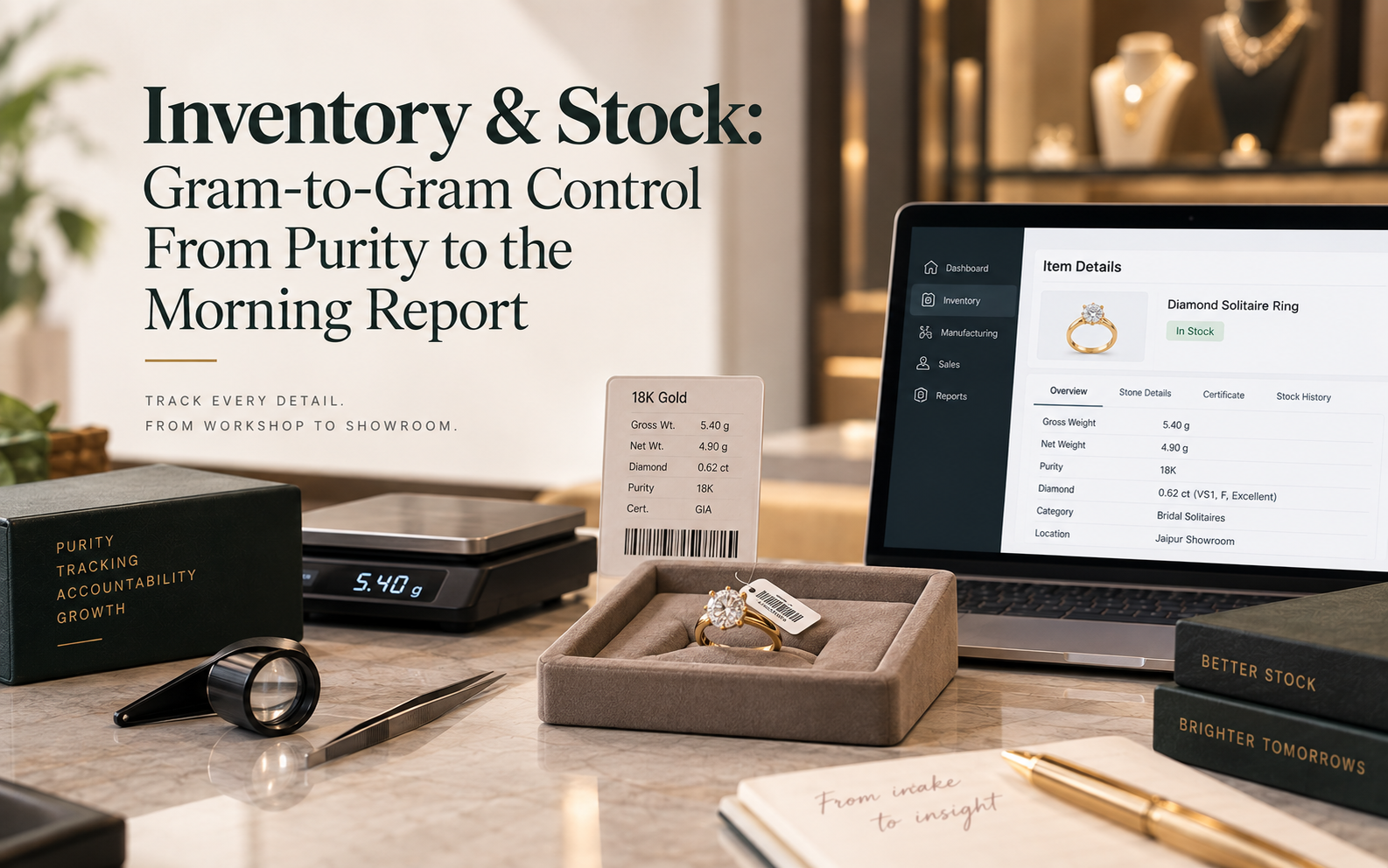
On the fourteenth of March, a diamond solitaire ring arrives at a Jaipur showroom from the workshop. Gross weight 5.4 grams, 18K gold, a 0.62 carat centre stone. By the time it sells four months later, that one ring will have passed through ten different layers of tracking. Weight, purity, stone grading, certification, live location, rate history. A detour back to manufacturing, an adjustment, a category, and finally a valuation and a morning report the day it leaves the shelf.
Most jewellery software tracks these as ten separate features. What actually matters is that they never lose the thread connecting them back to this one ring. The moment that thread breaks, the business is no longer looking at the ring, it's looking at ten disconnected guesses about it.
March 14th: The Ring Is Weighed the Moment It Arrives
Before a price, a design name, or a display case, the ring is a weight. This is weight-based stock tracking at its most basic: 5.4 grams gross, 4.9 grams net once the stone setting is accounted for, and a fine gold figure calculated against 18K purity, not assumed from the karat stamp alone. This number becomes the anchor every later valuation refers back to. Get it wrong here, off by even a tenth of a gram, and every number downstream inherits that error silently.
The Centre Stone Gets Properly Graded
The centre stone is 0.62 carat, VS1 clarity, F colour, excellent cut. None of that is visible to a customer glancing at the case. All of it is the actual reason this ring is priced differently from a visually similar 0.60 carat stone two shelves over with a lower clarity grade. Diamond 4C tracking, grading a stone properly at intake rather than pricing off size and a rough visual impression, is what keeps two similar looking rings honestly priced apart.
The Stone's Certificate Is Attached to the Ring Itself
The stone's certificate, the document that backs up everything just graded, gets attached to this specific ring's record through stone certificate tracking. It doesn't sit separately in a certificate binder that someone has to cross reference later. Six months from now, if a customer or an insurer asks for proof, the answer is a lookup, not a search. And if that certificate can't be produced quickly, the cost isn't paperwork, it's a customer who starts wondering whether the grading was ever real in the first place.
Every Branch Can See This Exact Ring Is Available
The ring goes into the Jaipur showroom's main display case. A customer at the same company's second branch, forty minutes away, asks a staff member there whether anything similar is available. The answer comes back immediately, this exact ring, in Jaipur, available now, because real-time stock status doesn't live separately at each branch, it's the same live number checked from anywhere. Our guide to jewellery billing software covers what that same live check looks like from the billing screen once a customer decides to buy.
The Ring's Tag Keeps a Full History of Rates and Movement
The ring is tagged the day it arrives, and that tag carries a full daily rate and barcode history from that point on. The gold rate it was valued at on intake stays attached to the tag. So does every later movement, between a display case and a back office valuation check. Four months on, nobody has to ask how long this has actually been sitting here and get a shrug for an answer. The tag already knows.
The Ring Goes Back to the Workshop for Resizing
In May, a customer likes the ring but needs it resized down. It leaves the display case and goes back into manufacturing as a work in progress job, not simply removed from stock and forgotten until it reappears. It sits inside a clearly defined WIP group for resizing jobs specifically, distinct from new production. Anyone checking on it finds it in the right place, not buried inside everything currently on a workshop bench. This is also the exact moment a business either knows precisely how much metal is sitting outside the showroom at any given time, or doesn't. The gap between those two states is where unexplained shrinkage quietly builds up over a year.
The Resized Weight Gets Recorded as a Proper Adjustment
Resizing a ring removes a small amount of metal, and this one comes back at 5.37 grams instead of 5.4. That difference gets entered as a proper stock journal adjustment, tied to the resizing job, not quietly absorbed into the next valuation as an unexplained rounding difference. Six months from now, if anyone asks why this ring's recorded weight changed, there's an actual answer on file.
The Ring Is Filed Under the Right Category
The ring lives inside the shop's own item group hierarchy, Bridal Solitaires, under Diamond Jewellery, the way the sales team already talks about the collection. Not a flat alphabetical product list that has nothing to do with how anyone in the shop actually thinks about the catalogue. A salesperson trying to find every bridal piece under two carats for a customer comparing options shouldn't have to scroll past earrings and bangles to get there.
At Month End, the Ring Gets Valued Accurately
At the end of May, closing valuation runs across every piece in stock. This ring's number is built from everything already on file, its fine weight, its graded stone, its resize adjustment, not a flat rate applied uniformly across the case. If an auditor ever asks how this specific number was reached, every layer behind it is already there to show.
The Morning Report Flags the Ring Before It Finally Sells
The ring finally sells on July 2nd. The morning before, the daily stock status summary had already flagged it. On the shelf 110 days, no movement in three weeks, a candidate for a closer look or a gentle nudge to a salesperson. It wasn't a coincidence that it sold the next day. Our guide to a jewellery management system covers what that same morning view looks like as part of a full connected day.
One Ring, Ten Layers, One Continuous Record
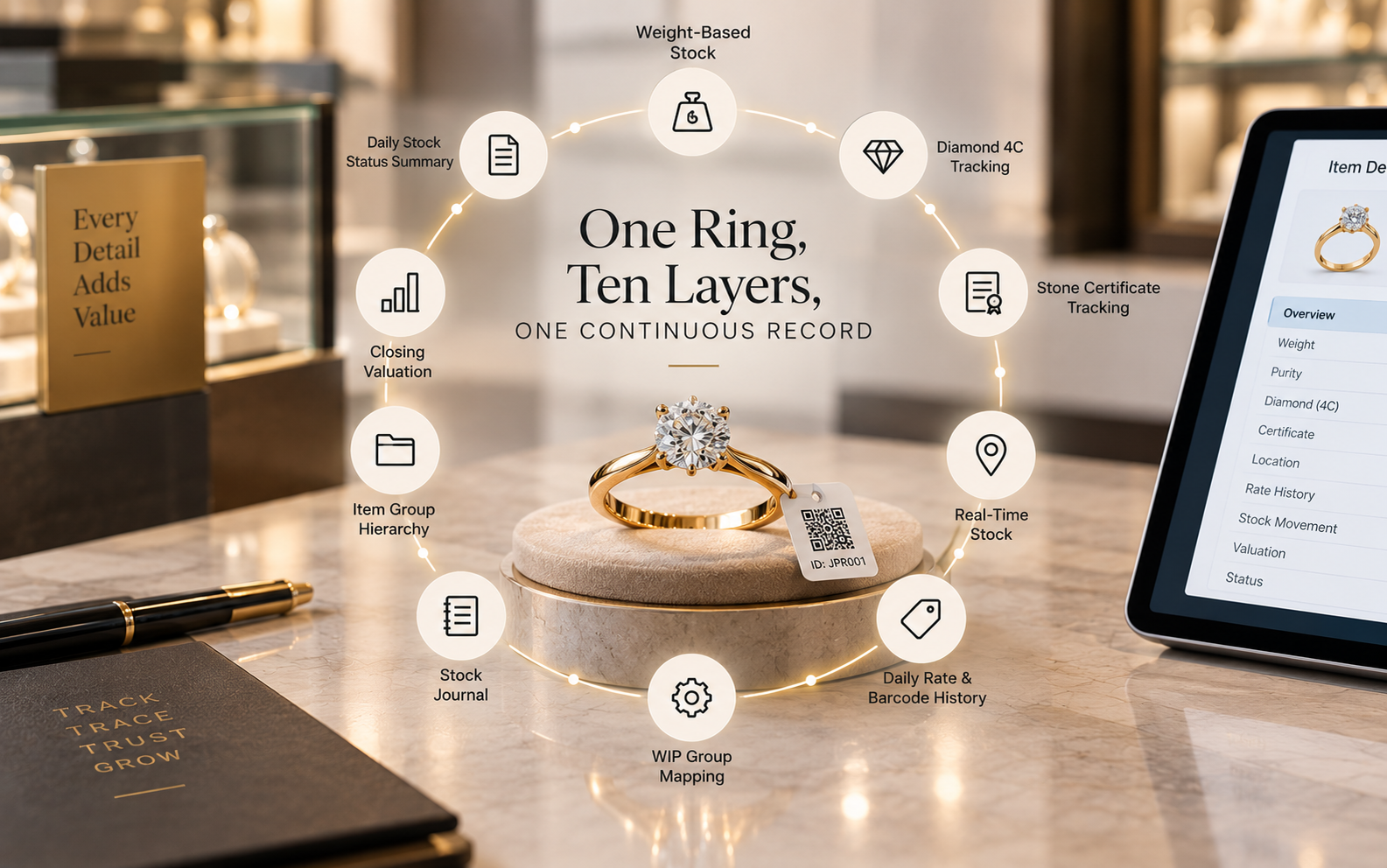
None of this was ten separate systems agreeing to cooperate. It was one ring's record, added to and referenced at every step, from a gross weight on March 14th to a sale on July 2nd. The moment any one of those ten layers lives somewhere else, the thread breaks. A spreadsheet for certificates, a separate register for resizing jobs, a mental note for how long something's been on the shelf, any of these is enough. The next person who needs that history has to reconstruct it instead of just looking it up.
What's actually being protected across all ten of these moments isn't the ring. It's the two things a jewellery business survives on: the margin on that specific piece, and the customer's confidence that the number on the tag means something. Every gap in the thread chips away at one or the other. An unrecorded resize, a certificate nobody can find, a stock count that doesn't match what's on the shelf.
Our guide to jewellery inventory management covers the live stock visibility side of this in more depth. Our guide to jewellery accounting software covers how a valuation like this one flows into the wider ledger. Our guide to jewellery ERP software covers how inventory connects to billing, purchase, and accounting on the same ledger.
Frequently Asked Questions
What's the difference between gross weight, net weight, and fine weight?
Gross weight is the total weight of a piece including stones and other materials. Net weight typically excludes stone weight, leaving just the metal. Fine weight adjusts that metal weight for purity, giving the actual gold or silver content. All three need to be tracked separately since they answer different questions.
Why does diamond 4C tracking matter if two stones look the same to a customer?
Cut, colour, clarity, and carat determine value even when two stones appear visually similar. Pricing based on visual estimate rather than graded attributes risks either underpricing a better stone or overpricing a lesser one, both of which erode trust or margin over time.
Does real-time stock work across multiple branches?
Yes, live availability should be visible across every counter and location from any single point, not just the branch a staff member happens to be standing in. Our guide to jewellery inventory management covers this multi-location visibility specifically.
How does stock journal differ from just editing a stock number directly?
A direct edit leaves no record of what changed or why. Stock journal requires every adjustment to go through voucher control, creating a documented, traceable transaction instead of a silent change that's impossible to audit later.
What makes closing valuation different from just multiplying stock by the current rate?
Accurate closing valuation depends on purity, weight type, and stone value all being correct at the item level, not a flat rate applied uniformly across different purities and stone compositions. Getting it wrong at day end usually means it was already wrong somewhere upstream in how the item was tracked.
See Every Layer Connected on Your Own Stock
JewelBiz's Inventory and Stock module tracks weight, purity, diamond 4C, stone certificates, real-time availability, barcode history, manufacturing groups, and valuation all against the same item record. A daily summary is ready before the shop even opens. If you want to see how it handles your own stock's specific mix, reach out at info@slatebiz.com or call +91 92573 73668, or visit slatebiz.com to book a walkthrough.